Tuesday, May 12, 2015

Alumni Association of MARDI (MASMARDI) - the 8th AGM and its Activities


 1. Introduction.  The 8th Annual General Meeting was held on Thursday March 26, 2015 at the Main Hall, MARDI, Serdang.  Its program was made up of three components - the opening ceremony,  forum discussion and the Annual General Meeting.

 2. Opening Ceremony.  My opening remarks as President of the Association include, among other things:
              (a) remind delegates as to continue leading a balanced life of keeping healthy, active and
                   happy.  The Association has an active program on this with a a training module         
                   developed towards a holistic health and stress management 
              (b) continue to keep in touch with members all over the country with the visit of the 
                    Committee members to the eastern coast states of Kelantan, Terengganu and Pahang 
                    soon after the big flood.  The Association donated financial contribution to 20 members 
                    in Kelantan, 1 in Terengganu and 2 in Pahang. The Committee members also took the
                    opportunity to visit members who are sick and bed-ridden
              (c) the Bureau of Ekonomy is active in pursuing ways of obtaining funds for the Association                     through the Sustaining Associates and business activities
              (d) congratulated MARDI on its recent restructuring with its activities focus on the                
                    following areas/centres - horticulture, paddy, biotechnology and nanotechnology,          
                    engineering, gene bank and seed, agrobiodiversity and environment, soil and crop 
                    science, economic and social
  Dr. Umi Kalthum, Deputy Director-General of MARDI, who officiated the Meeting, recapitulated
that MARDI wishes to continue to have a strong affiliation with the Alumni members and that the Institute will continue to look after their welfare and at the same time numerated the facilities that 
members can enjoy. She expressed the wish that members of the Alumni will indirectly assist the Institute in guiding young researchers and that the Association, with members of long working experiences in different disciplines could continue to contribute to the nation.                 


At the registration desk
Members of the Committee welcoming members 
View of the participants

  3. The Forum.  The forum discussed 'Culture for Innovation' and the paper was presented by Dato' Ariff Othman.  In my introduction, chairing the discussion, I highlighted the many challenges faced by the global community and the country, among them are food security; depletion of such resources as fossil fuels, land and biodiversity; rapid urbanization; pollution of the environment and the associated climate change.  Accordingly, there is the urgency of generating appropriate technologies and innovations and a parallel strategy to build the culture for innovation among scientists in research institutions such as MARDI.
  Dato' Ariff pointed out that organizational culture, made up of values, beliefs, underlying assumptions, attitudes and behaviors, plays an important role in achieving success in an institution.
Among the strategies to enhance this culture in an organisation include training programs that expose new officers to the mission, vision, objectives, plans of action of the organisation; leadership development programs which provide managers with tools for becoming 'better leaders'; and change management initiatives which facilitate the changes in the structure and programs designed to increase organisational effectiveness.  With a strong organisational culture, the researchers and the supporting staff are receptive to the introduction of new ideas, goods, services and practices which are intended to be useful i.e technology innovation covering both product and process development and ultimately the commercialization of the processes and products. A dynamic innovation ecosystem will provide benefits to the stakeholders - the research institutions, knowledge transfer centres, entrepreneurs, financiers and the society.
  Concluding the forum discussion, I emphasize that efforts in inculcating culture for innovation also include lots of reading, interacting with experts in a particular field and recognizing the clientele the technologies are developed for.
      
Delivering the welcoming address

Committee Members
Refreshments provided at the AGM

3. Annual General Meeting.  The AGM was called to order at 12.00 noon with the attendance of 40 members.
   The Progress Report that was tabled highlighted the following:
    (a) activities of the Association planned and executed were aimed at increasing membership and
         and enhance its finance; strengthen fellowship, interactions and involvement of members in the          Association; promote the culture of balanced living - keeping healthy, active and happy; having          an efficient and professional administrative machinery of the Association.
    (b) the planning and implementation of activities are undertaken by Bureau (Biro), as follows:
          
          Intellectual & Communication with MARDI - organises forum and encourages members to
          participate in courses, seminars; reading and writing.
          Economy - undertakes business activities and seeks donors for financial contributions
          Sports and Recreation - organises sporting and recreational activities for health
          Welfare
          Spiritual and Religious
          Public Relations

Posted on May 12, 2015
Comments may be communicated to:
hashim.abdulwahab@gmail.com   


Wednesday, March 25, 2015

International Conference on the New World Order - a Recipe for War or Peace


Poster of the Event at PICC

1. Introduction.  The Conference was held on March 9, 2015 at the Putrajaya International Convention Centre (PICC), Putrajaya, organised by the Perdana Global Peace Foundation (PGPF) as part of its long term agenda to abolish war.  It was participated by an estimated 500 representing the government deparments, corporate sectors, the foreign missions, students and representatives of various NGOs. In his opening remarks, Tan Sri Dato' Sri Norian Mai, Chairman of PGPF, indicated that the Foundation began with the launching of the Kuala Lumpur Initiative to Criminalise War in December 2005, as a forum to actively promote global peace and abolish war .  A series of conferences have been held on the issue and at the same time the Foundation has established a number of outreach programmes and undertaken humanitarian aids activities such as aid for Gaza, Somalia and refugees in Lebanon.

2. Keynote Address on the 'New World Order' (NWO) and Panel Discussion.  The keynote address delivered by YABhg Tun Dr Mahathir bin Mohamad, President of PGPF, was quite critical of NWO which, according to him, was conceptualised by the powerful, rich Western nations to establish an elitist world government to dominate the world.  These countries, together with their capitalistic corporations and armed forces have built up their military and economic might to ensure that countries toe their lines; take measures to subvert and undermine countries; regulate trade to favour them; impose their moral values against our own.  As a result there are many conflicts particularly in the Middle East.  It appears that the NWO is a recipe for war.  The panel discussion which ensued was chaired by Tan Sri Ahmad Fuzi Abdul Razak, former Secretary-General of the Ministry of Foreign Affairs Malaysia and was constituted of the following six members:

     a. Thomas P.M Barnett of Barnett Consulting LLC who started his deliberation on a positive note in that the world has been peaceful for a long period in history; there is more wealth and freedom; limited proliferation of nuclear weapons; rapid urbanisation which is concomitant with democratisation; availability of food to feed the increasing population; ageing population.  We are less likely to get killed by war and that wars are fundamentally state-based conflicts.  He concluded that the future be filled with LOVE and CARING.

     b. Dr Michel Chossudovsky, Founder of the Centre for Research on Globalisation, Canada and author of eleven books, came up strong with the statement that global wars on terrorism is in fact a US undertaking and that many organisations considered terrorist were the creation of US, NATO, Saudi Arabia, Qatar and Turkey.  Wars, to him, is a criminal undertaking.

    c. Dr Din Syamsuddin, Professor of Islamic Political Thought  at State Islamic University, Jakarta and President of Muhammadiyah, Indonesia was more conciliatory in his deliberation and looked at the NWO as partnership to develop a world system to eliminate poverty and construct a culture of peace, caring and sharing - sharing of space, coexistence whilst, at the same time, conserve and protect the environment.  To Dr. Din, the security of the globe is a collective responsibility and not the exclusive right of the powerful and that we must strive to eliminate global injustices; ensure human rights, freedom and tolerance.  He suggested that we need to work together on ethics and religion.

     d. Dr Chandra Muzaffar, President of The International Movement for a Just World and author of more than 20 books, postulated that President Bush in 1991 was the advocate of the NWO with the
intention of sustaining the US as a superpower.  To enable to do so it has to continue building its 
military strength, control currency and resources of the world, control the minds and hearts through 
culture and the media; bring regime change and appropriate action against recalcitrant states.  It has 
manipulated religion for defeating its enemy like in Afghanistan and has created terrorist organisations such as the Al-Qaeda.  The US looks at the globe as four hegemonic parts: contain China, concern for Russia, role of NATO to contain Ukraine and continue to have countries of South America under its patronage.

     e. General Elias Hanna (Rtd), Professor at the American University of Beirut, touched on the geopolitics of the Middle East and the US as a superpower was the cause of the many crises in the region.

      f. Yoichi Shimatsu, Former Editor of Japan Times, focused his attention on detecting hidden warfare such as coups and clandestine operations in countries, mysterious disappearance of airplanes and tragedies, cyber attacks, outbreak of diseases such as Ebola virus, establishment of IS caliphates.  


YABhg Tun Dr Mahathir bin Mohamad, President of PGPF, delivering his keynote address 
Panel discussion

A cross-section of the participants at the Conference

  3.  Launching of book on Abolishing War and Panel Discussion on Abolishing War.  The book on Abolishing War, authored by Prof. Johan Galtung, Professor of Peace Studies, was launched by YABhg Tun Dr Mahathir Mohamad. Prof. Galtung then delivered his keynote address on the topic which encompassed Criminalising War, Removing War Causes and Removing War as Institution and the address introduce the topic of abolishing war to the panelists of the afternnon session.  The panel was made up of the same speakers as the first seesion.  However, the second seesion was chaired by General Tan Sri Mohd Azumi Mohamed (Rtd).  The salient points covered can be summarised as follows:

             * that many conflicts had religious origin, interfaith dialogues might be a mechanism to
                reduce tension by practicing universal common values
             * to abolish war is a logical initiative
             * abstain from association with anything to do with war
             * strengthen international institutions
             * abide by the international rules of law
             *  amend the constitution of nation states 'to forever renounce war as a soveeign right of
                 the nation'
              * ban weapons of mass destruction (WMD)
              *since wars begin in the mind of people, 'maximise the brain to minimise war'
              * set the mind of abolishing war right from school

_______________________________________________________________________________

Posted on 25/3/2015
Comments on the article or blog could be communicated to the email
hashim.abdulwahab@gmail.com    

Saturday, March 14, 2015

Malay Renaissance Movement - Mammoth Unity Gathering


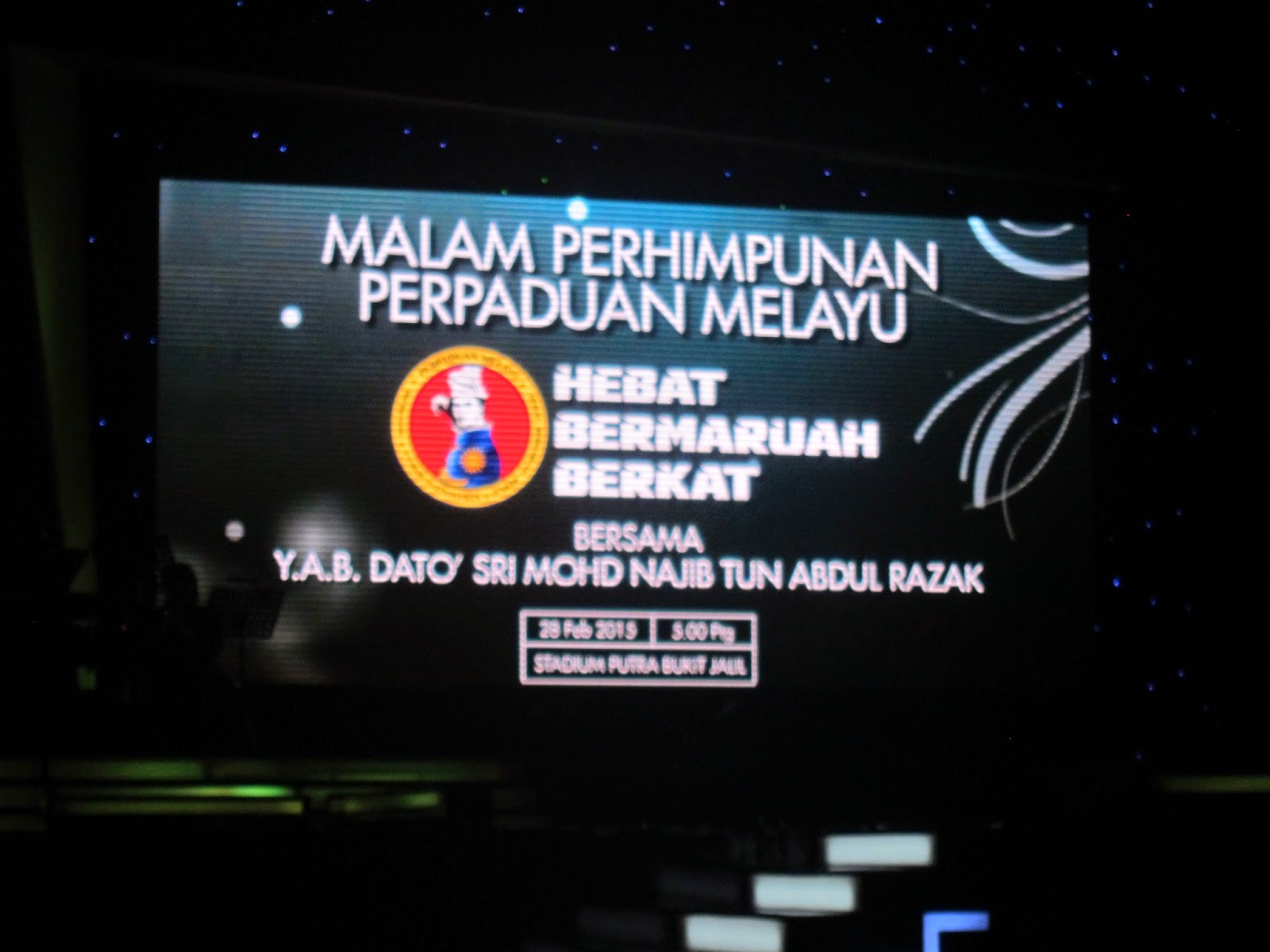
1.  Introduction.  The gathering was held on Saturday February 28, 2015 at the Putra Stadium, Bukit Jalil, with the objective of bringing together Malay communities representing political parties, government servants, the armed forces, the police, the academicians and scholars, student leaders, Islamic leaders, corporate leaders, business and entrepreneurs and the young generations, to create and establish a Movement to undertake the revival and transformation of the Malays into a dynamic, strong, united and respected ethnic community, guided by  the Malay Renaissance spirit of being courageous, wise, hardworking, strive for excellence and caring.  It was jointly organised by the Malay Consultative Council (MPM) together with UiTM, MARA, Dewan Bahasa dan Pustaka, Teraju, JAKIM and Gagasan 1 Malaysia with Dato' Seri Idris Jusoh, the leader of the Malay Renaissance Movement (MRM) as the driving force of the Gathering.  It was participated by an estimated 20 000 from from all over the country. Among the VIPs present were YAB Dato Seri Mohd Najib bin Tun Abd Razak, the Prime Minister; YB Dato' Seri Ismail Sabri Yaakob, Minister of Agriculture and Agrobased Industries; YB Dato' Seri Shahidan Kassim, Minister in the PM's Department; YB Dato Seri Abdul Wahid Omar, Minister in the PM's Department and representatives of MPM.       

YB Dato' Seri Idris Jusoh, the mover of the Malay Renaissance Movement

YAB Dato' Seri Najib signing the Waad Melayu  

2. Programme at the Gathering.  The gathering started with the maghrib prayer and the 'doa'. It was followed by video presentations of MRM and the launching of its logo.  In his address to launch the Movement and the Gathering, YAB Dato' Seri Najib listed seven 'amanat' (principles) that should be the guiding forces to transform the Malays.  Firstly, to fight in upholding  Islam and its teachings, as promulgated in the Federal Constitution; secondly, to protect the the institution of the Malay rulers, their privileges and the privileges of the 'bumiputras' as provided in the Constitution; thirdly, committed to uphold the maqasid syariah; fourthly, to strengthen the economic status of the Malays so that they can be competitive both at the national and international levels; fifthly, to give focus and priority in educating and training of the Malays to uplift their knowledge and skills, creative and innovative with global thinking but yet adhering to Malay cultural roots; sixthly, to nurture positive values such as fighting spirit, courageous and patriotic and reject negative values such as jealousies and enmities among ourselves;  seventhly, strengthen family institution by instilling such values as respect for each other, assisting and helping each other and loving and caring for each other. 
 To me, the most meaningful agenda and highlight of the Gathering was the launching of the Bumiputra Agenda Initiatives which, among them, are as follows:

    2.1 Appointment of Malay Renaissance Ambassadors among the young leaders

    2.2 Special educational programme for young children known as INMIND

    2.3 Establishment of an Education Endowment Fund with a target of RM 1.0 Billion by UiTM Alumni

    2.4 DBP as storehouse of knowledge

    2.5 Establishment of an Investment Cooperative with a target of 1.0 million members - MPM

    2.6 Local-2-Global Corporation Ascend 800 - MPM and SME Corporation

    2.7 MARA Corp to be developed as super GLC & Anchor Corporation - MARA

    2.8 Program Industri Halal Bumiputra - HDC

    2.9 Satu Keluarga Satu Syarikat - GABEM

   2.10 Pembangunan Syarikat TERAS Bumiputra - Teraju
     
Performing the maghrib prayer 
The participants filled the whole Putra Stadium

Performance by a few artists as part of the programme

  Posted on March 14, 2015
  Kindly post your comments to:
  hashim.abdulwahab@gmail.com